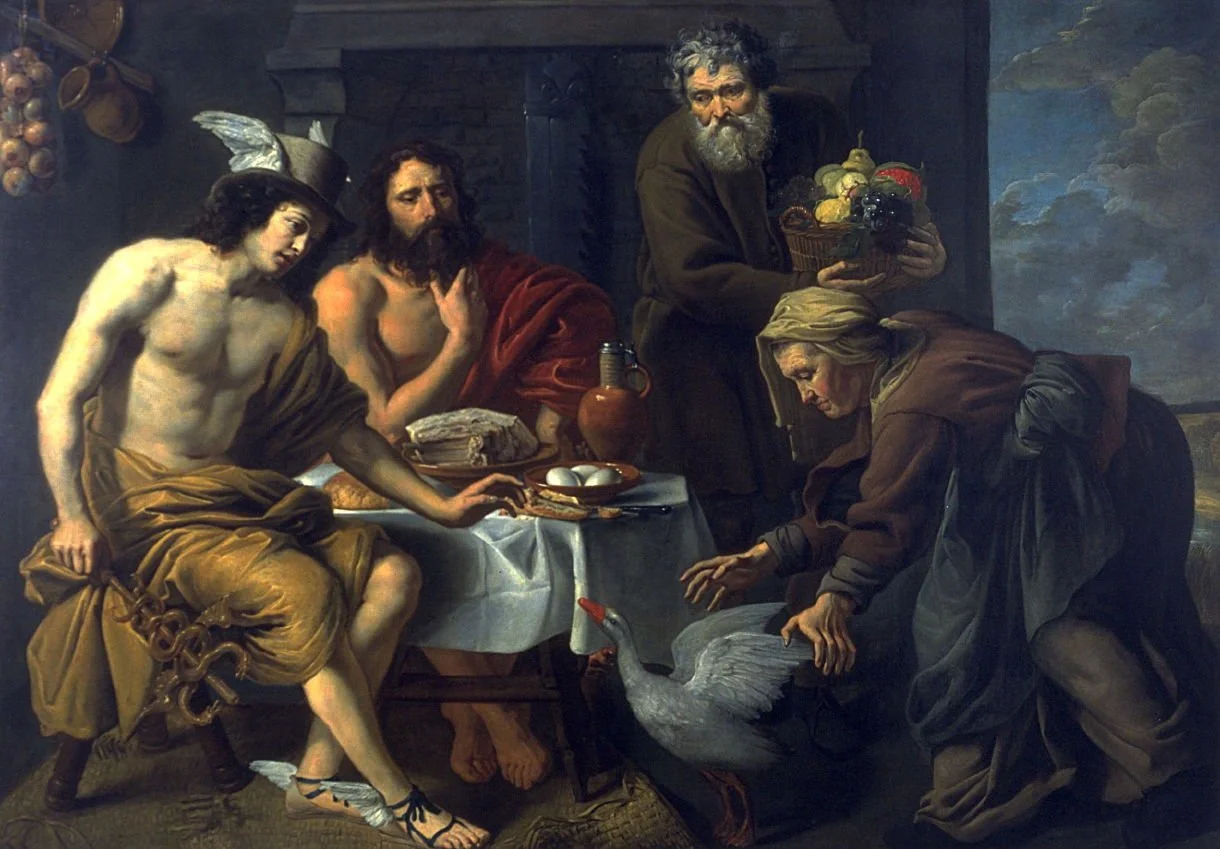
Philemon and Baucis
Some personal translations of Ovid.
Selections I enjoyed, enough to capture them myself through the process of translation.
Creation
cum, quae pressa diu fuerant caligine caeca,
sidera coeperunt toto effervescere caelo
When, having been suppressed for a long time in a blind haze,
The stars begin to shine through the whole world.
Pyramus
aut ultor vestrae, fidissima pectora, mortis, aut comes, ero
I shall come either as the avenger of your deaths, most loyal bodies, or as your companion.
Nunc duo concordes anima moriemur in una.
Now two joint souls shall die in one.
Cupid Shoots Pluto
ille pharetram
solvit et arbitrio matris de mille sagittis 380
unam seposuit, sed qua nec acutior ulla
nec minus incerta est nec quae magis audiat arcus,
oppositoque genu curvavit flexile cornum
inque cor hamata percussit harundine Ditem.
He unfastened his quiver
And at the will of his mother, he chose
One arrow out of a thousand, but one sharper than the others,
Not less uncertain, one which listens to the bow more,
And stabilised it against his knee, he bent
The flexible horn and struck Dis in the heart with a barbed arrow.
The Death of Emathion
fuit et grandaevus in illis
Emathion, aequi cultor timidusque deorum, 100
qui, quoniam prohibent anni bellare, loquendo
pugnat et incessit scelerataque devovet arma;
huic Chromis amplexo tremulis altaria palmis
decutit ense caput, quod protinus incidit arae
atque ibi semianimi verba exsecrantia lingua 105
edidit et medios animam exspiravit in ignes.
There was the aged Emathion among them,
A man who cherished courage and fear of the gods,
Who, since his years forbade him from fighting, he fought with words,
Didn’t stop cursing their wicked arms.
As he clung to the altar with his trembling hands,
Chromis cut off his head with a sword, which fell onto the altar
And half dead, the tongue was spitting out curses
And the spirit gave out in the middle of the flames.
Medea
sed trahit inuitam noua vis, aliudque cupido
mens aliud suadet; uideo meliora proboque,
deteriora sequor. quid in hospite regia uirgo
ureris et thalamos alieni concipis orbis?
But a new force drags me unwillingly, desire one way,
Reason tempts another; I see and approve of what is better,
Yet I follow what is worse. What royal virgin should desire a guest
And join in marriage to an alien from another world?
Baucis and Philemon
esse sacerdotes delubraque vestra tueri
poscimus, et quoniam concordes egimus annos,
auferat hora duos eadem, nec coniugis umquam
busta meae videam, neu sim tumulandus ab illa
We ask to be priests and the guardians of your temples,
And once we have shared our years together,
The same hour shall take us both, so that
I shall not see my wife’s tomb, nor shall I be buried by her.
frondere Philemona Baucis,
Baucida conspexit senior frondere Philemon.
iamque super geminos crescente cacumine vultus
mutua, dum licuit, reddebant dicta "vale" que
"o coniunx" dixere simul, simul abdita texit
ora frutex…
Baucis saw Philemon flowering,
Old Philemon saw Baucis was in leaf.
Now over the top, there grew two faces,
While it is still permitted, they returned words at the same time,
“Farewell, my love’ and at the same time,
Their mouths were covered by the bark.
Byblis
protinus, ut secto piceae de cortice guttae,
utve tenax gravida manat tellure bitumen;
utve sub adventu spirantis lene favoni
sole remollescit quae frigore constitit unda;
sic lacrimis consumpta suis Phoebeia Byblis
vertitur in fontem, qui nunc quoque vallibus illis
nomen habet dominae, nigraque sub ilice manat
And so, as drops flow from the cut bark of a pine tree,
As sticky tar oozes from the pregnant earth,
Or as water, once made frozen by the cold, softens again in the sun,
Upon the approach of the gently breathing West Wind.
Thus, consumed by her own tears,
Phoebian Byblis turns into a fountain, which even now, those valleys
Have the name of their mistress, which flows beneath the black oak.
Aesacus
Indignatur aemans invitum vivere cogi
obstarique animae misera de sede volenti
exire.
The lover is indignant, he is forced to live against his will,
And the miserable soul is obstructed from leaving his life voluntarily
The Love of Polyphemus
Telemus interea Siculam delatus ad Aetnen, 770
Telemus Eurymides, quem nulla fefellerat ales,
terribilem Polyphemon adit "lumen" que, "quod unum
fronte geris media, rapiet tibi" dixit "Ulixes."
risit et "o vatum stolidissime, falleris," inquit,
"altera iam rapuit."
Meanwhile, Telemus was taken down to Sicilian Etna,
Telemus, son of Eurymus, whom no bird had ever deceived,
Said to terrible Polyphemus, “Odysseus shall take from you,
The one light which you bear in the middle of your head.”
He smiled and said “Oh most foolish of seers, you are mistaken,
Another has already taken it.”
Ovid’s Speechplay with Achelous
incinctus iuvenis flexis nova cornua cannis
Young man’s new crown wreathed with curved reeds.
The Speech of Pythagoras
'O genus attonitum gelidae formidine mortis,
quid Styga, quid tenebras et nomina uana timetis,
materiem uatum, falsique pericula mundi?
corpora, siue rogus flamma seu tabe uetustas
abstulerit, mala posse pati non ulla putetis;
morte carent animae semperque priore relicta
sede nouis domibus uiuunt habitantque receptae.
O people petrified by the cold forms of death,
Why do you fear the Styx, what shades, and empty names,
The stuff of seers, and dangers of a false world?
Bodies, whether a flame consumes them or old age wastes them away,
You cannot judge them to suffer any misfortune;
Our souls are free from death and always,
Having left behind their former residence, live in new homes and are received to live there.
…
omnia mutantur, nihil interit. errat et illinc
huc enit, hinc illuc et quoslibet occupat artus
spiritus eque feris humana in corpora transit
inque feras noster, nec tempore deperit ullo.
utque nouis facilis signatur cera figuris,
nec manet ut fuerat nec formas seruat easdem,
sed tamen ipsa eadem est, animam sic semper eandem
esse sed in uarias doceo migrare figuras.
ergo, ne pietas sit uicta cupidine ventris,
parcite, uaticinor, cognatas caede nefanda
exturbare animas, nec sanguine sanguis alatur.
All are changing, nothing dies. The spirit wanders here and there,
It occupies whatever body it pleases, and moves between human bodies,
And in animals, but does not perish at any time.
As soft wax stamped with a new design,
It does not remain, but changes its shape,
But however, it is still the same wax itself, thus there is always the same soul,
But it changes to many new forms. Therefore,
Lest one’s piety may be conquered by desire, refrain,
I foresee, from driving out kindred spirits with nefarious destruction,
Nor let blood be nourished by blood.
'Quid? non in species succedere quattuor annum
aspicis, aetatis peragentem imitamina nostrae?
nam tener et lactens puerique simillimus aeuo
uere nouo est; tunc herba recens et roboris expers
turget et insolida est et spe delectat agrestes.
omnia tum florent, florumque coloribus almus
ludit ager, neque adhuc uirtus in frondibus ulla est.
transit in astatem post uer robustior annus
fitque ualens iuuenis; neque enim robustior aetas
ulla nec uberior nec quae magis ardeat ulla est.
excipit autumnus, posito feruore iuuentae
maturus mitisque inter iuuenemque senemque
temperie medius, sparsus quoque tempora canis.
inde senilis hiems tremulo uenit horrida passu,
aut spoliata suos aut quos habet alba capillos.
What? Don’t you see that the year passes by in four distinct sections,
Imitating our passage through life?
For in the new age of soft spring, flowing with sap, is similar to human childhood, in its stage of life;
Then the fresh grass, without strength, swells up,
it is soft and delights farmers with its hope.
Then all flowers, and the field plays with coloured flowers, nourished,
Though the leaves are still weak.
It moves into summer after spring and becomes a more sturdy, healthy youth;
For no other age is more strong, nor burn more ardent than this one.
Autumn follows, when that fervour of young men
Has faded, a mild age between youth and old age,
A tempered middle, also a time with sparse white hair.
From there, old winter comes in, trembling and shaking,
And hair has all been stolen, turned white.
Ovid’s Envoi
sic magnus cedit titulis Agamemnonis Atreus, 855
Aegea sic Theseus, sic Pelea vicit Achilles;
denique, ut exemplis ipsos aequantibus utar,
sic et Saturnus minor est Iove: Iuppiter arces
temperat aetherias et mundi regna triformis,
terra sub Augusto est; pater est et rector uterque. 860
di, precor, Aeneae comites, quibus ensis et ignis
cesserunt, dique Indigetes genitorque Quirine
urbis et invicti genitor Gradive Quirini
Vestaque Caesareos inter sacrata penates,
et cum Caesarea tu, Phoebe domestice, Vesta, 865
quique tenes altus Tarpeias Iuppiter arces,
quosque alios vati fas appellare piumque est:
tarda sit illa dies et nostro serior aevo,
qua caput Augustum, quem temperat, orbe relicto
accedat caelo faveatque precantibus absens! 870
Iamque opus exegi, quod nec Iovis ira nec ignis
nec poterit ferrum nec edax abolere vetustas.
cum volet, illa dies, quae nil nisi corporis huius
ius habet, incerti spatium mihi finiat aevi:
parte tamen meliore mei super alta perennis 875
astra ferar, nomenque erit indelebile nostrum,
quaque patet domitis Romana potentia terris,
ore legar populi, perque omnia saecula fama,
siquid habent veri vatum praesagia, vivam.
Thus great Atreus yielded to Agamemnon,
Aegeus to Theseus, Peleus was defeated by Achilles;
Then, so that I use an example to match them,
Thus Saturn is lesser than Jupiter; Jupiter makes mild
The citadels of the sky, and rules the three-form world,
The land is beneath Augustus; he is either father or rector.
Gods, I pray, comrades of Aeneas, to whom sword and fire yielded,
O Gods of Rome and father of the city Romulus,
And unconquered Gravides, father of Romulus,
And sacred Vesta, household gods of Caesar,
And with you domestic Phoebus, of Caesarean Vesta,
And you, O Jupiter who holds the high citadels of Tarpeia,
And all others for whom it is just for a poet to call upon:
May the day be tardy, and come in a later age,
Where the head of Augustus, which he governs, approach,
May he leave the world, and ascend to the heavens, where,
absent, he may look favourably upon those who pray to him.
Now I have completed my work, and not Jupiter,
Nor fires, nor a sword, nor devouring time can abolish it.
When it chooses, let that day, which holds authority on nothing but this body,
Let it bring an end to the span of my uncertain life.
However, the greater part of me shall be carried with wings
Above the high stars, and my name shall be unforgettable,
Wherever Rome extends her power to conquered lands,
I shall be on the mouths of people, if the forebodings of poets have any truth,
And in fame, through all ages, I shall live.